The future of design will not belong to the people who use AI to avoid thinking.
It will belong to the people who use AI to think more deeply.
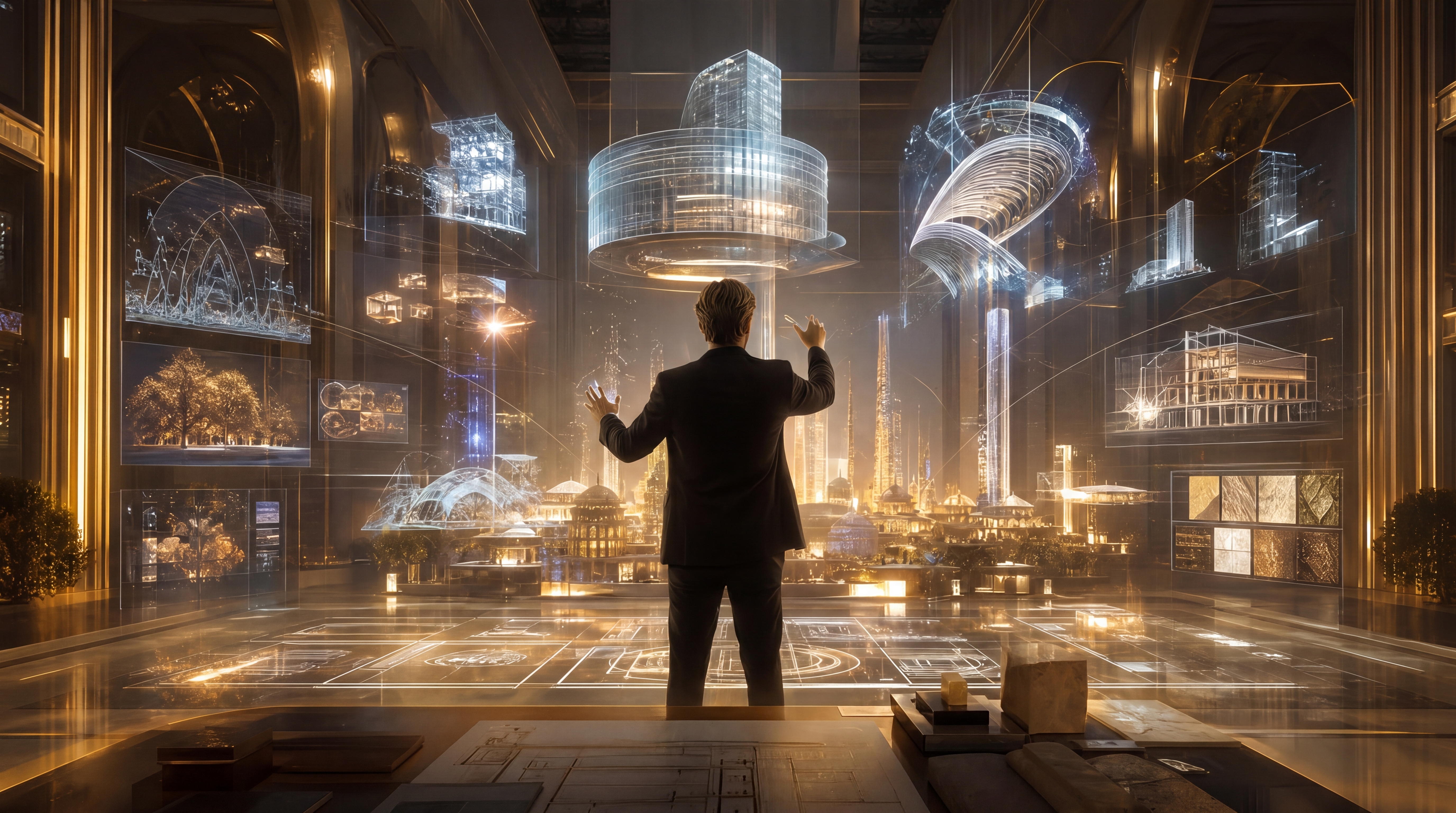
The same is true of mixed reality. The point is not to escape into spectacle, strap screens to our faces, and call it innovation. The point is to dissolve the barrier between imagination and spatial experience. Designers should be able to stand inside what does not yet exist, test it, reshape it, collaborate around it, and bring it into physical reality with greater clarity.
AI and mixed reality are not side tools. They are becoming a new creative environment.
For architecture, product design, interiors, urbanism, fashion, and nearly every field that shapes matter, this shift is not optional. The tools of creation are changing. Designers can either become passive consumers of that change, or they can become the ones who direct it.
0MNI is built on a simple conviction: technology should not replace the soul of design. It should remove friction from the act of creation so the designer can operate with more imagination, more responsibility, and more precision.
The Problem With the Current Workflow
Most design workflows are still strangely indirect.
A designer imagines a spatial reality, then translates it into sketches, diagrams, references, CAD drawings, 3D models, renderings, schedules, coordination sets, and presentations. Each medium is useful, but each one also introduces distance between the original intent and the final experience.
The designer thinks in atmosphere, movement, pressure, light, sound, touch, and human presence.
The software asks for clicks, layers, commands, coordinates, panels, and file exports.
This mismatch has shaped the profession for decades. We have become fluent in tools that often do not think the way designers think. We use flat screens to design immersive space. We orbit digital objects from outside instead of inhabiting them from within. We evaluate rooms through images rather than bodily experience.
The result is not just inefficiency. It is a narrowing of imagination.
When tools are too rigid, designers unconsciously design within the limits of the interface. The software begins to discipline the mind. Forms become easier to produce if they match the tool’s assumptions. Workflows reward what can be documented quickly, not always what should be explored deeply.
AI and mixed reality offer a way out—not by making design effortless, but by making the medium more aligned with the act of creation itself.
AI as a Creative Translation Layer
AI is often discussed as if its main purpose is to generate images. That is the shallow version.
The deeper potential of AI is translation.
A designer can describe intent in natural language: the atmosphere, constraints, performance goals, structural logic, cultural references, emotional qualities, material direction, and desired human experience. AI can help translate that intent into options, models, diagrams, scripts, schedules, simulations, variations, and critiques.
This does not mean the AI becomes the designer.
It means the designer gains a computational collaborator capable of moving between languages: word to form, sketch to model, model to performance analysis, precedent to strategy, concept to detail, atmosphere to material system.
Used poorly, AI produces generic output at high speed. Used well, it expands the designer’s ability to search, test, compare, and refine.
The distinction is intent.
If the designer has no clear concept, AI will multiply vagueness. If the designer has a strong vision, AI can multiply exploration. It can generate alternatives that expose hidden assumptions. It can identify conflicts earlier. It can assist in producing scripts, assemblies, documentation, or visual studies that would otherwise consume hours of repetitive labor.
The best designers will not be those who ask AI for “cool buildings.”
They will be those who can direct intelligence with clarity.
Mixed Reality Restores the Body to Design
Architecture and spatial design are embodied disciplines. Yet much of the design process happens outside the body.
We view space through a monitor. We zoom, pan, rotate, and render. We understand scale numerically before we feel it physically. We may not realize a ceiling is oppressive, a corridor is too long, an entry lacks gravity, or a stair feels awkward until far too late.
Mixed reality changes this.
It allows designers, clients, consultants, and communities to occupy the unbuilt. A proposed room can be experienced at full scale. A façade can be overlaid on its actual site. A product can be inspected on a table before it exists. A structural conflict can be seen in space rather than discovered through abstract coordination. A client who struggles to read plans can finally understand what the design will feel like.
This is not just visualization. It is spatial truth-testing.
A rendering can flatter a design. A plan can conceal awkwardness. But when you stand inside a space—even a virtual or mixed reality version—certain truths become harder to ignore.
The body knows.
Mixed reality brings the body back into the design process earlier, when change is still possible.
Faster Iteration, Deeper Judgment
Speed is often treated as the main benefit of AI. That is true, but incomplete.
Speed only matters if it creates room for better judgment.
If AI allows a designer to produce twenty options instead of three, the value is not the number twenty. The value is the ability to compare possibilities, discover the strongest direction, and understand why it is strongest. If mixed reality allows a team to walk through a project before construction, the value is not novelty. The value is catching what drawings missed, refining the human experience, and preventing expensive mistakes.
The goal is not faster mediocrity.
The goal is deeper iteration.
Design is rarely a straight line from idea to outcome. It is a process of discovery through making. You propose, test, see, revise, and test again. AI and mixed reality accelerate that loop. They help designers externalize ideas quickly, inhabit them, critique them, and return to the work with sharper understanding.
This can improve early concept design, massing, environmental performance, accessibility studies, fabrication logic, user experience, client communication, construction coordination, and post-occupancy learning.
The workflow becomes less like drafting a fixed object and more like cultivating a living system.
Better Collaboration Across Disciplines
Modern projects are too complex for isolated genius.
Architects, engineers, developers, contractors, fabricators, planners, owners, users, and public agencies all shape the final outcome. Yet these groups often work through fragmented media and delayed feedback. Misunderstandings accumulate. Decisions are made from incomplete mental models.
AI and mixed reality can create a more unified field of collaboration.
Imagine a design review where the architect, structural engineer, mechanical consultant, client, and contractor are all looking at the same immersive model. The AI can summarize conflicts, surface code implications, generate alternate routing strategies, compare cost impacts, and record decisions. The team can see the consequences of a choice in real time rather than waiting for another coordination cycle.
This does not remove professional expertise. It makes expertise more visible and actionable.
A structural engineer can explain load paths spatially. A contractor can flag constructability issues while standing inside the assembly. A client can understand scale without pretending to read technical drawings fluently. A designer can defend the concept not with vague language, but with an inhabited experience.
The result is not only efficiency. It is alignment.
AI Will Raise the Standard, Not Lower It
Some designers resist AI because they fear it will cheapen creativity. That fear is understandable. The internet is already flooded with synthetic images that look impressive for three seconds and collapse under scrutiny. There is a real risk of aesthetic inflation: more images, less meaning.
But the answer is not to reject the tools.
The answer is to raise the standard.
As generation becomes easier, discernment becomes more valuable. Taste becomes more valuable. Conceptual clarity becomes more valuable. Technical knowledge becomes more valuable. Spiritual and ethical grounding become more valuable. Anyone can produce a seductive image; fewer can produce a coherent, buildable, responsible, human-centered reality.
AI will expose weak designers who rely only on style.
It will empower strong designers who understand concept, craft, context, and consequence.
The profession should not ask, “Will AI make designers irrelevant?”
It should ask, “What kind of designer becomes more necessary in an age where images are cheap?”
The answer: designers who can judge, integrate, steward, and lead.
Mixed Reality Will Change Client Expectations
Clients are also changing.
As immersive tools become more accessible, people will increasingly expect to experience proposals before approving them. Static boards and still renderings will not disappear, but they will feel incomplete for many project types. Why look at a room from a camera angle when you can stand inside it? Why approve a massing from a diagram when you can walk the site with the digital building overlaid at scale?
This shift will reward designers who can communicate spatially.
It will also make deception harder. Overly dramatic render angles, selective views, and atmospheric tricks will have less power when clients can move through the design themselves. That is good for the profession. It forces the work to carry integrity beyond the image.
Mixed reality makes design more accountable.
It lets people ask better questions earlier: Is this entry clear? Is this space generous enough? Does the building meet the street well? Does the view matter from here? Does the furniture layout actually work? Does this object feel as elegant at human scale as it looked in a rendering?
The answers will improve the work.
The Sacred Futurist Use of Technology
0MNI’s position is not that every new technology is automatically good. Tools carry assumptions. They can distract, flatten, addict, accelerate vanity, or distance us from reality if we use them without wisdom.
But tools can also restore.
AI can remove repetitive friction so designers can spend more time on judgment, concept, and care. Mixed reality can restore embodiment to a process trapped behind glass. Real-time simulation can reveal whether a poetic idea can stand against wind, gravity, heat, water, and time. Spatial computing can help communities understand proposals that would otherwise remain hidden inside technical drawings.
In a Sacred Futurist framework, technology is not worshiped. It is ordered.
The Creator remains above the creation. The human person remains more important than the machine. Beauty remains bound to goodness and truth. Innovation remains accountable to restoration.
This matters because powerful tools amplify the spirit of the person using them. If the intent is vanity, AI will scale vanity. If the intent is extraction, mixed reality will become another sales theater. But if the intent is service, restoration, excellence, and reverence, these tools can help bring better realities into being.
A New Workflow for Designers
The emerging design workflow will look less like a linear software pipeline and more like an immersive conversation between human intent, machine intelligence, spatial experience, and physical truth.
A designer begins with a concept and speaks it clearly.
AI helps generate early massing studies, precedents, material strategies, environmental hypotheses, and possible structural logics.
The designer enters the space through mixed reality, testing scale, light, circulation, and atmosphere.
The AI observes feedback, compares options, checks constraints, and helps revise.
Consultants join the environment, identifying conflicts and opportunities.
The design evolves as a buildable spatial reality rather than a pile of disconnected representations.
Documentation still matters. Codes still matter. Budgets still matter. Drawings still matter. But they are no longer isolated from the living experience of the project.
The workflow becomes more whole.
Mastery Over Fear
Designers should not fear AI and mixed reality. But they should not be naïve about them either.
The right posture is mastery.
Mastery means learning the tools without surrendering judgment. It means using AI to expand exploration without outsourcing taste. It means using mixed reality to deepen spatial understanding without confusing immersion for truth by itself. It means remembering that tools can show possibilities, but designers must choose what is worthy.
The future will need designers who can speak across domains: concept, code, atmosphere, structure, simulation, ethics, theology, fabrication, narrative, and human experience.
This is not the end of design.
It is the return of design to its fuller scale.
We are moving toward a world where creators can speak intent, shape digital matter with their hands, test physics in real time, invite others into the unbuilt, and carry refined visions into physical reality.
That future should not make designers smaller.
It should demand that they become more awake.
---
CTA
0MNI is building toward a future where AI, mixed reality, and sacred creative intent converge inside a new kind of design environment. Follow the evolution of the 0MNI Creation Studio and help define the next era of immersive creation.