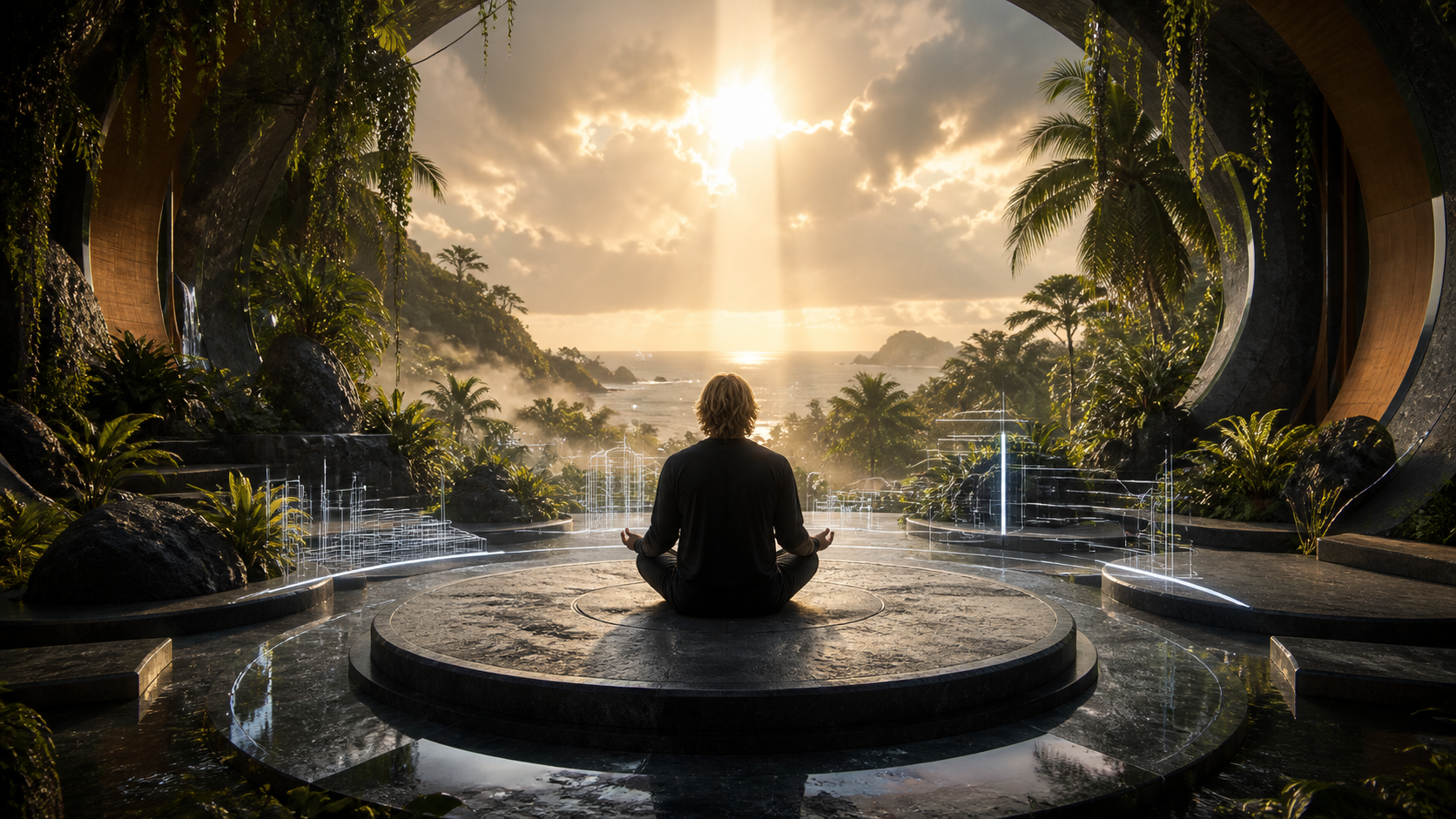
Before the sketch, before the model, before the first beautiful image appears on the screen, there is a quieter act available to the Christian designer.
Prayer.
Not as decoration. Not as a religious preface before the “real” work begins. Not as a way to sanctify our own preferences after we have already chosen them. Prayer, at its best, is the moment the designer remembers that creativity is not self-originating. It is received, stewarded, disciplined, and returned.
The question is not merely, What do I want to make?
The deeper question is: Lord, what is this work being called to become?
That question does not make the process vague. It makes it more serious. It places the designer, the client, the site, the material, the budget, the future occupants, and the unseen consequences of the work under the gaze of God.
Design is never neutral. It shapes attention, movement, memory, dignity, comfort, and desire. A room can make a person feel small or welcomed. A building can heal a street or turn away from it. A product can honor material intelligence or become another disposable object. A digital environment can deepen imagination or scatter the soul.
For the Christian designer, this matters because the world is not accidental. Matter is not meaningless. Beauty is not a luxury floating above truth. Light, proportion, craft, order, atmosphere, and human dignity all belong to a created world that still bears the fingerprints of its Maker.
So design becomes more than problem-solving.
It becomes stewardship.
And stewardship begins by listening.
Prayer Is Not a Replacement for Skill
Prayer does not excuse laziness. It does not replace research, coordination, precedent study, material testing, code review, cost discipline, or technical rigor. It does not make a weak plan strong, a bad detail buildable, or a shallow idea profound.
If anything, prayer should make the designer more disciplined.
To pray before designing is to admit that the work matters beyond personal expression. It will affect real people. It may consume land, money, labor, energy, and time. It may outlast the mood that produced it. It may become part of someone’s daily life long after the designer has moved on.
That kind of responsibility should sober us.
A prayerful designer should not hide behind vague inspiration. Reverence should sharpen excellence, not soften it. The designer who prays should also draw carefully, test assumptions, study the site, listen to counsel, revise honestly, and refuse the comfort of impressive but hollow ideas.
Faithful design is not less rigorous.
It is more accountable.
The First Surrender Is Ego
Design attracts ego because design gives visible form to invisible thought. It is easy to confuse the work with ourselves. The more gifted a designer becomes, the more subtle the temptation becomes.
We can speak about service while secretly protecting our image.
We can speak about innovation while chasing recognition.
We can speak about beauty while building a shrine to self.
Prayer interrupts that disorder. It reminds the designer that creativity is not ownership in the ultimate sense. We participate in making, but we do not originate the mystery of creation itself.
This does not diminish the designer. It dignifies the designer.
The potter is not less skilled because clay is real. The musician is not less creative because sound has order. The architect is not less visionary because creation has a Creator.
Humility does not make the work smaller. It frees the work from the burden of proving our greatness.
Listening Through the Whole Process
Divine guidance is not always a lightning bolt. Sometimes it is quieter than that. Sometimes it appears through Scripture, conscience, silence, wise counsel, constraint, correction, or the strange peace that arrives when a design finally stops performing and starts serving.
A designer may listen through the character of the site.
Through the needs of the people who will inhabit the work.
Through the material that refuses to become something dishonest.
Through the budget that demands restraint.
Through the client’s fear, hope, confusion, or longing.
Through the friction that reveals vanity.
Prayerful design asks better questions:
- Does this honor the people who will live with it?
- Does it tell the truth about its materials and purpose?
- Does it serve life, or merely spectacle?
- Does it exploit attention, or cultivate presence?
- Does it steward resources wisely?
- Does it bring order where there was confusion?
- Does it leave room for beauty that is not loud?
- Does it participate in restoration?
These are not separate from design. They are design.
They shape plan, form, threshold, material, light, circulation, craft, and cost. They help the designer resist the shallow answer and search for the faithful one.
The Sacred Without Sentimentality
Christian language in design can become sentimental if it is not anchored in reality. Reverence is not softness. Sacredness is not achieved by adding warm light, arches, natural materials, or poetic captions. Those things may be powerful in the right context, but they are not holiness.
A design becomes spiritually serious when it becomes truthful.
Truthful to the site.
Truthful to the people.
Truthful to the budget.
Truthful to material behavior.
Truthful to the difference between beauty and vanity.
There is nothing reverent about pretending. If a project is structurally irresponsible, socially indifferent, environmentally careless, or aesthetically manipulative, spiritual language cannot rescue it.
Prayer should lead the designer away from theatrical spirituality and toward embodied faithfulness.
Sometimes the faithful design is not the most dramatic. Sometimes it is the most restrained. Sometimes it is the one that gives dignity to an overlooked hallway, shade to a harsh sidewalk, quiet to a crowded home, or grace to a modest budget. Sometimes it is the one that refuses to waste simply because waste can be afforded.
God is not impressed by spectacle detached from obedience.
Beauty as Witness
Beauty matters because creation is not merely functional. God made a world that is useful, but also radiant. The universe could have been efficient without being astonishing. Yet light fractures into color. Trees branch with order and wildness. The ocean moves with terrible majesty. The human face carries mystery. The heavens declare glory without needing permission from modern utility.
Beauty is not extra.
But beauty must be rightly ordered.
It should not manipulate, dominate, distract from injustice, or become an idol. Beauty at its best is witness: a visible sign that the world is not meaningless and that human beings are worth honoring.
The prayerful designer does not ask only whether a thing is beautiful. The prayerful designer asks how beauty should serve.
Should this space lift the eyes? Should it quiet the spirit? Should it gather people around a shared center? Should it frame creation rather than compete with it? Should it make the ordinary feel cared for? Should it offer rest in a culture of agitation?
These are aesthetic questions, but they are also pastoral, civic, and human questions.
Technology Needs Discernment
We are entering an era where designers can generate images, models, simulations, and immersive worlds with unprecedented speed. AI, mixed reality, procedural modeling, and spatial computing can expand imagination, reveal options, test performance, and let us inhabit the unbuilt before it becomes physical.
But more power does not automatically mean more wisdom.
This is why prayerful discernment becomes more important, not less. The faster the tools become, the deeper the designer’s moral and spiritual clarity must become. Technology can multiply intent, but it cannot purify intent. It can generate possibilities, but it cannot decide what should be loved.
A prayerful design process does not reject advanced tools. It orders them.
The question is not only, What can we make now?
The better question is, What is worthy of being made, and what kind of future does it invite?
0MNI’s vision of Sacred Futurism lives in that tension: advanced computational creation joined to spiritual humility. Voice, AI, spatial computing, simulation, and immersive environments are not pursued as toys of novelty. They are pursued as instruments of stewardship, capable of helping designers manifest ideas with greater clarity, responsibility, and reverence.
A Practical Posture for the Christian Designer
Prayer can become part of the workflow without becoming performative.
Begin with surrender. Before opening the model, offer the work back to God. Confess the desire for control, recognition, or fear-driven decisions.
Listen before imposing. Study the site, the people, the need, and the constraints as places where wisdom may be revealed.
Ask for purification of intent. Not every exciting idea is a faithful idea. Not every impressive form serves the project.
Work with excellence. Draw carefully. Coordinate thoroughly. Test assumptions. Respect those who will build the work.
Pause at major decisions. When the project turns, ask again: Does this serve what is good, true, and beautiful? Are we forcing something? Are we ignoring something?
Receive correction. God often answers through other people, including clients, consultants, builders, critics, and communities.
End with gratitude. The work is never fully ours. Every good gift is received.
This posture does not guarantee ease. It does not mean every project will become profound. It does not remove conflict, revision, or disappointment. But it keeps the designer oriented toward faithfulness.
Designing Under the Gaze of God
To design under the gaze of God is to remember that architecture, objects, images, interfaces, and environments are made within His world, from materials He made, for people He loves.
That should change us.
It should make us less frantic, less vain, less cynical, and less willing to produce dead spaces for a wounded world. It should make us patient with the process and courageous about the outcome. It should make us hungry for excellence, but suspicious of ego. It should make us attentive to beauty, but obedient to love.
The Christian designer does not need to make every project look religious.
The deeper task is to make every project an act of faithful stewardship.
Sometimes that faithfulness will be visible in grandeur. Sometimes in restraint. Sometimes in innovation. Sometimes in repair. Sometimes in a quiet room where someone finally feels safe.
Before form, a prayer.
Before spectacle, obedience.
Before authorship, stewardship.
From the One flows the many, and every act of making is an opportunity to honor the Maker.
CTA
0MNI exists for designers who believe the future of creation should be both technologically powerful and spiritually awake. Join the Sacred Futurist movement and help shape work that honors God, serves people, and brings unseen possibilities into visible form.